Skala Solo moisture/dryer control system for batch dryers
The Skala Solo Moisture/Dryer Control System for batch dryers is a model-based control system that senses moisture inside the dryer and detects when the product reaches the desired final moisture. Learn how it uses two temperature sensors to stop the drying cycle at the target moisture and why that narrows the final moisture distribution.

Inside the dryer moisture sensing
The Skala Solo Moisture Control system consists of a model-based control algorithm that allows moisture sensing of the product inside the dryer. Skala Solo uses two temperature sensors inside the dryer to sense the moisture content of the product during the drying process. The system will stop the drying cycle as the desired final moisture content is reached.
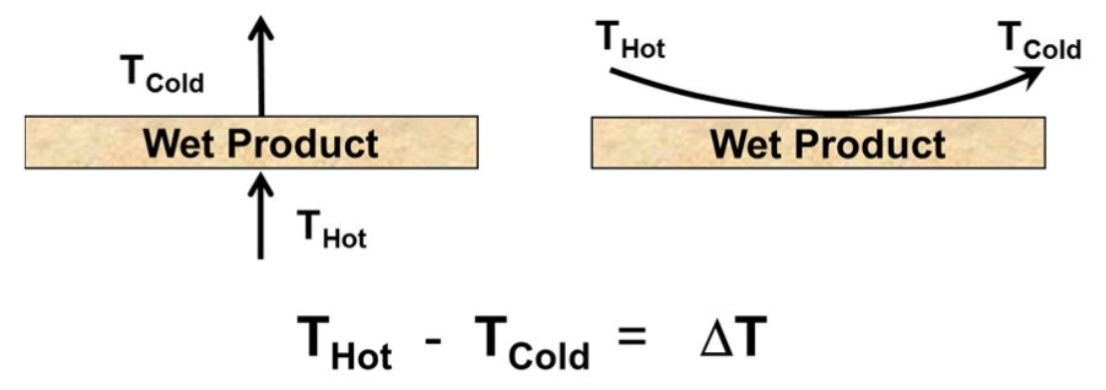
The patented Skala Solo Moisture Control System is based on a model that relates the moisture content of the product leaving a dryer to the temperature drop and drying time. The temperature is measured before and after contact with the product during drying and the difference between the two is used in the model to calculate the moisture content. Figure 1 illustrates the Skala Solo method.
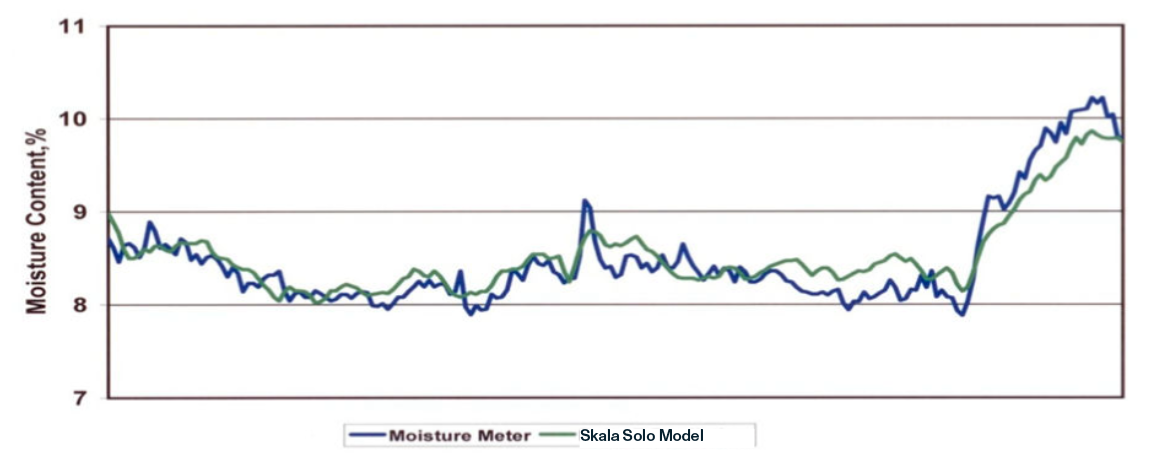
The Skala Solo model can be considered a soft sensor for sensing the moisture of the product inside the dryer. Figure 2 shows the product moisture calculated by a Skala Solo soft sensor versus a NIR moisture meter on a continuous rayon fiber dryer.
Frequently asked questions
How does Skala Solo sense moisture inside a batch dryer?
Skala Solo uses two temperature sensors inside the dryer. The temperature is measured before and after contact with the product during drying, and the difference between the two is used in a model that relates the temperature drop and drying time to the moisture content of the product leaving the dryer. The Skala Solo model can be considered a soft sensor for sensing the moisture of the product inside the dryer.
Why is drying for a fixed time a problem?
Batch dryers are typically set to run a certain number of minutes at a constant inlet temperature. Variations in the initial moisture content then cause proportional variations in the final moisture content. Under-dried material means the dryer is restarted and checked again, which adds drying time and lost production time. Over-dried material also loses production time and energy and may cause quality issues such as color and finishing issues in textiles or color and texture in food products.
How does Skala Solo know when to stop the drying cycle?
The temperature drop in the dryer is mainly due to the evaporation of water, so it is proportional to the moisture content. The Skala Solo model continuously recalculates the final Skala Solo set point for stopping the drying cycle at the desired moisture content, and the cycle stops once the actual Skala Solo reaches that set point. In some cases the rate of change in temperature drop is also used in the model to handle variance in the load.
What are the benefits of Skala Solo for batch dryers?
The Skala Solo system reduces moisture variation, which allows the moisture content to be increased and still safely stay below the upper control limits. This increase in mean moisture gives a better quality product, a production increase, and an energy savings. Recipes for products can be developed and recalled, and data for each drying cycle can be saved for later analysis.