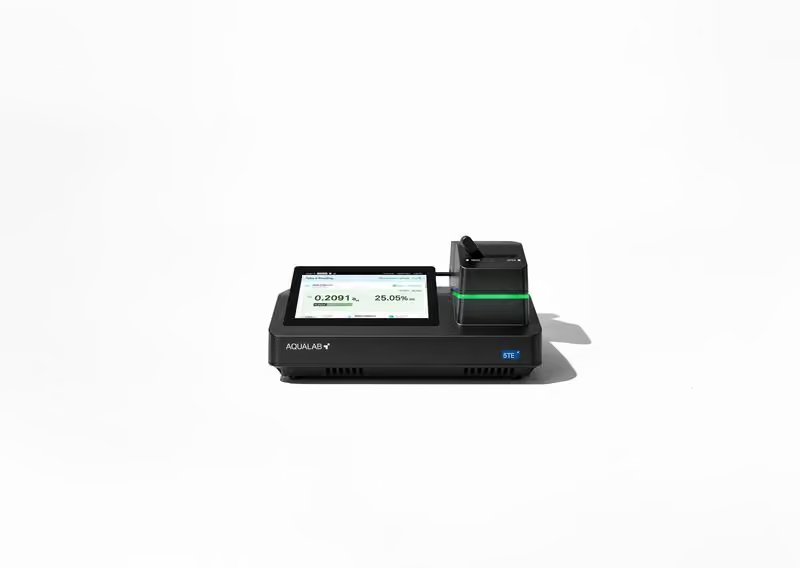
Volatile ingredients and water activity
A guide to choosing the best water activity sensor for your needs. AQUALAB instruments use dew point, capacitance, or tunable diode laser (TDL) sensors, and each handles interfering volatile compounds differently. See how common spices, herbs, essential oils, food additives, coffee, and teas perform on each sensor.

Introduction
AQUALAB produces instruments with three types of water activity sensors: a dew point sensor, a capacitance sensor, and a tunable diode laser (TDL) sensor. Each sensor has a unique way of measuring water activity (aw) and each sensor varies in its ability to accurately measure in the presence of interfering volatile compounds (VCs).
Traditionally the dew point sensor is the fastest and most accurate sensor, but it can struggle in the presence of VCs due to their co-condensation onto the chilled mirror. The capacitance sensor is able to overcome the condensation issue, but this type of sensor generally has a lower precision, a higher data acquisition time and can be poisoned by certain compounds (some alcohols have been shown to interfere). The TDL sensor was specifically designed to measure water activity in the presence of other volatile compounds and is the flagship instrument for this purpose.
This guide will cover many common ingredients found in food products or other consumables that you may encounter while developing recipes or formulations. The goal of this guide is to aid the end user in choosing an instrument that will best fit their needs for determining water activity across a wide spectrum of use cases. While many of the samples presented in this report contain volatile compounds or are themselves volatile, instrument performance varies greatly depending on the processing of these compounds or ingredients. Best and worst case scenarios will be presented when applicable and an instrument recommendation will be made based on typical use cases.
Procedure
Prior to running any samples, all instruments were calibrated and verified against a set of known aw standards. A representative sample of each ingredient was analyzed in a minimum of three individual instruments per sensor. Each sample was run until the instrument gave three readings within the sensor specification (Δaw accuracy: dew point ±0.003, capacitance ±0.015, and TDL ±0.005).
The spices used in this study were taken from a quickly rotating bulk foods section at a grocery store. The essential oils were sourced from a USDA organic supplier and marked for internal use. The other food additives used were all ACS reagent grade. All spices and essential oils were measured undiluted directly from their packaging. The other food additives were diluted with water to test a range of mass concentrations. No substrates were used – generally speaking additional substrates may lessen sample volatility.
Results
The data collected was reviewed to determine whether or not volatile compounds were interfering with the water activity measurements. Given the TDL sensor’s performance in the presence of volatile compounds, it was taken as the most accurate and set as the standard for comparing the other instruments. Using our sensor specifications, the additive Δaw was taken as the acceptable error. The stated sensor specification for the TDL is Δaw ± 0.005 and therefore the maximum acceptable error between two TDL sensors is the sum of the errors, or Δaw ± 0.01. Generally speaking a Δaw < 0.01 corresponds to a difference between instruments of 1–2% and is within the normal instrumental error. An error between Δaw ± 0.01 and 0.02 (3 and 5%) suggests some interference may be present, and above 0.02 (5%) the readings are significantly different and above twice the acceptable error, likely due to interfering volatile compounds.
Three levels of recommendations are given in the tables below. If an ingredient gives good performance at all concentrations then a dew point sensor is the best choice (non-interfering). If the sample is sufficiently volatile that it can cause issues with the dew point sensor at high concentrations, but fares well at lower concentrations then a dual block instrument is recommended (concentration dependent). If the ingredient causes inaccurate readings even at low concentrations then a TDL sensor is recommended (highly interfering).
These data points represent samples that a consumer would encounter. Fresh spices and herbs, perhaps directly from a producer, may have higher concentrations of interfering volatile compounds and will not perform to the same level of accuracy as our samples. Furthermore, volatile compound content of herbs and spices can vary widely depending on plant species, handling and processing, and storage and age. A literature review of the potential volatile compounds is found in the volatility profile of spices.
AQUALAB devices & sensors
Experimental results and volatility profile
Dried spices and herbs
Essential oils
Coffee and teas
† For the full data set, please request through your AQUALAB representative.
Conclusions
Dried spices and herbs
The herbs and spices presented in this report fall into three categories regarding their performance: non-interfering, concentration dependent, and highly interfering. The spices and herbs measured for this report were not diluted in any way, and it’s up to the end user to determine whether or not this represents their own samples.
Non-interfering: cayenne, medium chili, onion. A dew point sensor is best.
Concentration dependent: allspice, cinnamon, cumin, garlic, ginger, nutmeg, oregano, paprika, smoked paprika, white pepper. If using undiluted, a TDL is best, but at low concentrations a dew point sensor will work. A capacitance sensor is a good compromise.
Highly interfering: basil, black pepper, cloves, coriander, sage. A TDL is the best way to reliably measure these herbs and spices unless they are significantly diluted.
Essential oils
Clove oil, peppermint oil, lemon oil, rosemary oil all had dew point sensors fail due to mirror contamination. Cinnamon oil was able to be measured in a dew point sensor, but it gave a reading significantly higher than the average TDL reading.
If you are looking to determine aw of essential oils a TDL is the only reliable sensor given the low water content and high volatility of these mixtures.
Other food additives
The compounds presented in this report fall into two categories regarding their performance: non-interfering, and concentration dependent. There are numerous use cases for each of these components, and it’s up to the end user to determine what instrument best suits their needs. For example, distilled white vinegar is typically 5% acetic acid and if you need to regularly determine the aw for this type of sample, then you may need to consider a TDL. If you use samples containing diluted vinegar then a capacitance sensor may work well. If you know you have vinegar, but it’s a small percentage of your sample then a dew point sensor may be sufficient.
Non-interfering: ascorbic acid, citric acid, lactic acid, malic acid, glycerin. A dew point sensor will work well for typical concentrations in food.
Concentration dependent: acetic acid, ethanol, isopropanol, propylene glycol. A TDL is the best instrument, but a capacitance sensor instrument may also be sufficient.
Coffee and teas
Coffee is often problematic for a dew point sensor, but it is highly variable. There is variation from roast to roast and among varieties, but also between freshly ground vs. pre-packaged samples. If you are a coffee producer or roaster and are interested in determining the aw of your product then the best choice is an instrument with a TDL sensor.
Teas can be accurately measured with a dew point sensor so long as they aren’t flavored with highly volatile compounds, such as in some spiced teas. If you are a producer of spiced teas a TDL is necessary to accurately determine aw in the presence of essential oils.
References
- Stewart, Toni-Moy; Lowe, Henry; Watson, Charah. Quantification and characterization of Pimenta dioica (Allspice) essential oil extracted via hydrodistillation, solvent and supercritical fluid extraction methodologies. Am. J. of Essential Oils and Natural Products 2016, 4, 27–30.
- Janick, Jules. Basil: A Source of Aroma Compounds and a Popular Culinary and Ornamental Herb. Perspectives on New Crops and New Uses 1999, 499–505.
- Stojanovic-Radic, Zorica. Piperine – A Major Principle of Black Pepper: A Review of Its Bioactivity and Studies. Appl. Sci. 2019, 9, 4270.
- G. K. Jayaprakasha & L. Jagan Mohan Rao. Chemistry, Biogenesis, and Biological Activities of Cinnamomum zeylanicum. Critical Reviews in Food Science and Nutrition 2011, 51, 547–562.
- Viljoen, Alvaro. Eugenol – From the Remote Maluku Islands to the International Market Place: A Review of a Remarkable and Versatile Molecule. Molecules 2012, 17, 6953–6981.
- Mandal, Shyamapada, Coriander (Coriandrum sativum L.) essential oil: Chemistry and biological activity. Asian Pac. J. Trop. Biomed. 2015, 5, 421–428.
- Jiang, Zi-Tao; Li, Rong. Chemical composition of the essential oil of Cumunum cyminum L. from China. Flavor and Fragrance Journal 2004, 19, 311–313.
- An, Kejing; Wu, Jijun; Xu, Yujuan. Comparison of Different Drying Methods on Chinese Ginger (Zingiber Officinale Roscoe): Changes in Volatiles, Chemical Profile, Antioxidant Properties, and Microstructure. J. Food Chem. 2016, 197, 1292–1300.
- Piras, Alessandra; Rosa, Antonella; Marongui, Bruno; Atzeri, Angela; Dessi, Assunta; Falconieri, Danilo; Porcedda, Silva. Extraction and Separation of Volatile and Fixed Oils from Seeds of Myristica fragrans by Supercritical CO2: Chemical Composition and Cytotoxic Activity on Caco-2 Cancer Cells. J. Food Sci. 2012, 77, 448–453.
- Marques, Antonio. Chemical composition and bioactivity of different oregano (Origanum vulgare) extracts and essential oil. J. of the Sci. of Food and Ag. 2013, 93, 2707–2714.
- Andrea Böszörményi, Éva Héthelyi, Ágnes Farkas, Györgyi Horváth, Nóra Papp, Éva Lemberkovics, and Éva Szőke. Chemical and Genetic Relationships among Sage (Salvia officinalis L.) Cultivars and Judean Sage (Salvia judaica Boiss.) J. of Ag. and Food Chem. 2009, 57, 4663–4667.
- Halima, Nihed. Citrus lemon essential oil: chemical composition, antioxidant and antimicrobial activities with its preservative effect against Listeria monocytogenes inoculated in minced beef meat. Lipids in Health and Disease 2017, 16, 146.
- Schmidt, Erich. Chemical Composition, Olfactory Evaluation and Antioxidant Effects of Essential Oil from Mentha x piperita. Nat. Prod. Comm. 2009, 4, 1107–1112.
- Carbonell-Barrachina, Angel. Composition of rosemary essential oil (Rosmarinus officinalis) as affected by drying method. J. Food Eng. 2010, 97, 253–260.
- Ochiai N, Tsunokawa J, Sasamoto K, Hoffmann A. Multi-volatile method for aroma analysis using sequential dynamic headspace sampling with an application to brewed coffee. J Chromatogr A. 2014, 1371, 65–73.
- Cadwallader, Keith; Wu, Tiandan. Identification of Characterizing Aroma Components of Roaster Chicory “Coffee” Brews. J. of Ag. and Food Chemistry. 2019, 67 (50), 13848–13859.
Frequently asked questions
Which water activity sensor is best for volatile ingredients?
The TDL sensor was specifically designed to measure water activity in the presence of other volatile compounds and is AQUALAB’s flagship instrument for this purpose. A dew point sensor gives good accuracy for non-interfering ingredients, and a capacitance sensor is a good compromise for concentration dependent ones.
How much difference between instruments is acceptable?
The TDL specification is Δaw ± 0.005, so the maximum acceptable error between two TDL sensors is Δaw ± 0.01. A Δaw below 0.01 (1–2%) is within normal instrumental error, between 0.01 and 0.02 (3–5%) suggests some interference may be present, and above 0.02 (5%) the readings are significantly different, likely due to interfering volatile compounds.
Can I measure essential oils with a dew point sensor?
Generally not. Clove oil, peppermint oil, lemon oil, and rosemary oil all caused dew point sensors to fail due to mirror contamination, and cinnamon oil read significantly higher than the average TDL reading. A TDL is the only reliable sensor given the low water content and high volatility of essential oils.
Can a capacitance sensor be used for samples containing ethanol?
At ethanol concentrations of 1–5% a capacitance sensor can be used occasionally. Prolonged exposure to ethanol risks poisoning the capacitance sensor, causing irreversible drift that requires replacing the sensor. Above 5% ethanol, a TDL is the only recommendation.
Drive your company’s total moisture performance
Learn how