Water activity for food safety and quality
Water activity (aw) measures the energy status of the water in a product. Unlike moisture content, it predicts microbial growth, chemical and biochemical reactivity, texture, caking and clumping, moisture migration, and shelf life. Learn how water activity supports food safety and quality.

What can water activity do?
Water activity can limit microbial growth, prevent caking and clumping, predict moisture migration, influence chemical and biochemical reactivity, synergize with hurdle technology, determine shelf life, and do plenty more. A better question: what can’t it do?
Combine crackers at 20% water content and cheese filling at 30%. A recipe for soggy crackers? Not if the two ingredients have the same water activity.
Need to avoid clumping and caking in a batch of spices? Match the water activities of the components, and the problem is solved.
Vitamin degradation is a function of water activity. So are lipid oxidation, crunchiness, chewiness, softness, and many other factors of quality. Moisture content will tell you how much water is in a product, but that’s all. It can’t predict any of these other quality and safety issues.
Why water activity?
Water activity’s usefulness as a quality and safety measurement was suggested when it became evident moisture content could not adequately account for microbial growth fluctuations. Water activity is a measure of the energy status of the water in a system.
The water activity (aw) concept has served the microbiologist and food technologist for decades. It is the most commonly used criterion for safety and quality.
Predicting safety and stability
Water activity predicts safety and stability with respect to microbial growth, chemical and biochemical reaction rates, and physical properties. Figure 1 shows stability in terms of microbial growth limits and rates of degradative reactions as a function of water activity.
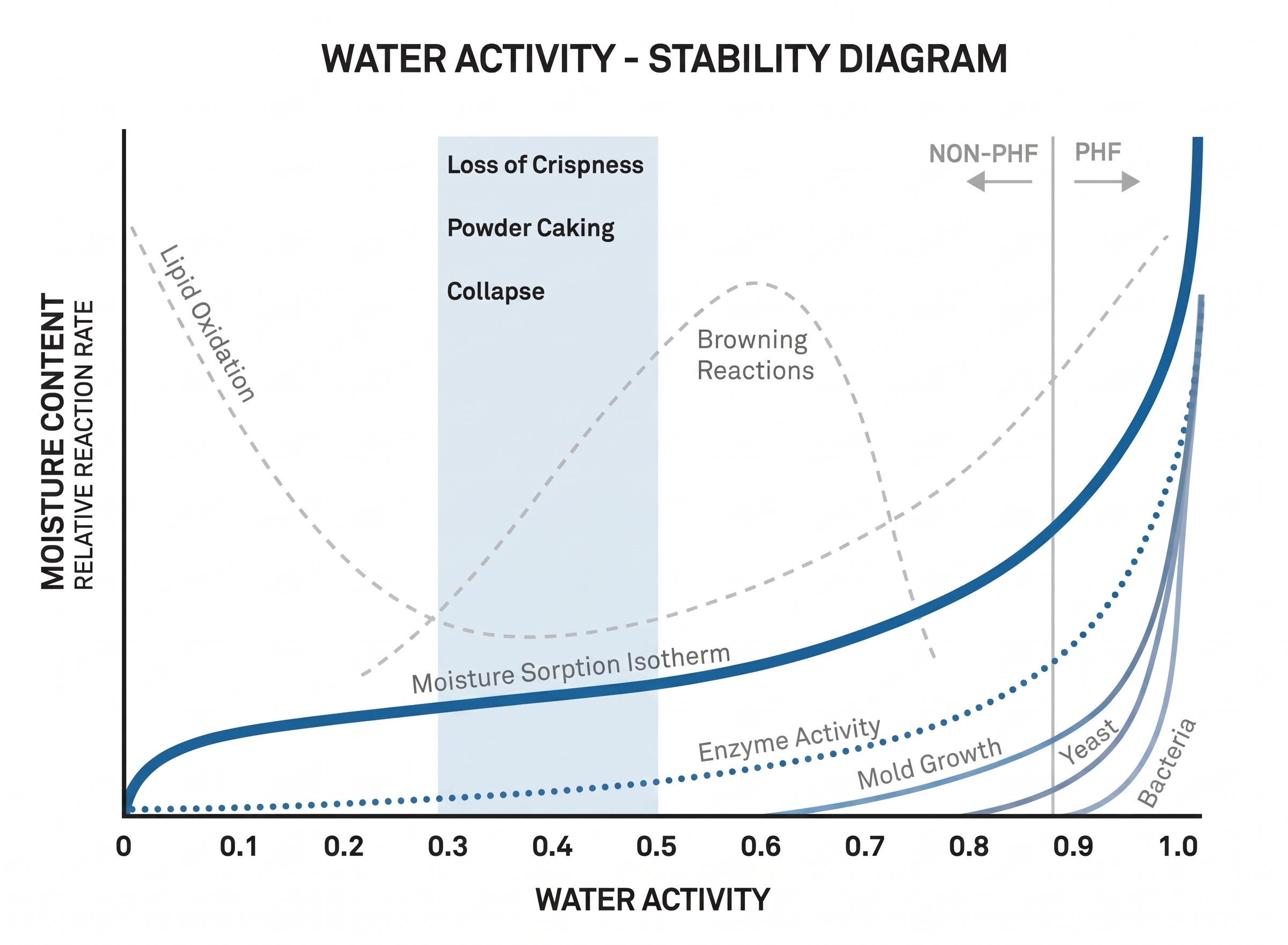
By measuring and controlling the water activity, it is possible to:
- Predict which microorganisms will be potential sources of spoilage and infection
- Maintain the chemical stability of products
- Minimize nonenzymatic browning reactions and spontaneous autocatalytic lipid oxidization reactions
- Prolong the activity of enzymes and vitamins
- Optimize the physical properties of products for moisture migration, texture, and shelf life
Limiting microbial growth
Microorganisms have a limiting water activity level below which they will not grow. Water activity, not moisture content, determines the lower limit of “available” water for microbial growth. Since bacteria, yeast, and molds require a certain amount of “available” water to support growth, designing a product below a critical water activity level provides an effective means to control growth.
Water may be present, even at high content levels, in a product, but if its energy level is sufficiently low, the microorganisms cannot remove the water to support their growth. This “desertlike” condition creates an osmotic imbalance between the microorganisms and the local environment. Consequently, the microbes cannot grow.
Hurdle technology
While temperature, pH, and several other factors can influence whether and how fast microorganisms will grow, water activity is often the most important factor. Water activity may be combined with other preservative factors (hurdles), such as temperature, pH, redox potential, etc., to establish conditions that inhibit microorganisms. The water activity level that limits the growth of the vast majority of pathogenic bacteria is 0.90 aw (0.70 aw for spoilage molds). The lower limit for all microorganisms is 0.60 aw.
Which water activity meter is right for you?
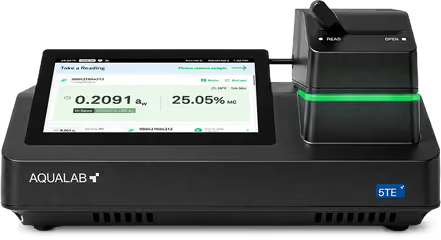
AQUALAB 5TE
Water activity and moisture content in a single 60-second test.
- MC + aw in one
- Results in 1 minute
- Accurate to ±0.003 aw
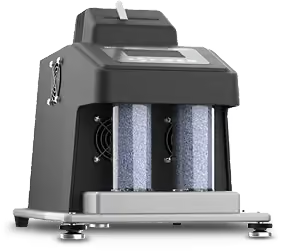
AQUALAB VSA
Make detailed moisture maps to predict, understand, and control moisture’s effects. High-resolution moisture sorption isotherms for shelf life prediction.
- Isotherms in <48 hours
- 200+ data points / isotherm
- 5 min. test setup
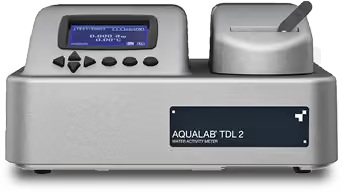
AQUALAB TDL 2
Precise water activity readings for volatile and complex samples.
- Tunable diode laser sensor
- Read highly volatile substances
- Accurate to ±0.005 aw
Chemical/biochemical reactivity
Water activity influences not only microbial spoilage but also chemical and enzymatic reactivity. Water may influence chemical reactivity in different ways. It may act as a solvent, a reactant, or change the mobility of the reactants by affecting the viscosity of the system. Water activity influences nonenzymatic browning, lipid oxidization, degradation of vitamins and other nutrients, enzymatic reactions, protein denaturation, starch gelatinization, and starch retrogradation. Typically, as the water activity level is lowered, the rate of chemical degradative reactions decreases.
Physical properties
Besides predicting the rates of various chemical and enzymatic reactions, water activity affects the textural properties of foods. Foods with high water activities have a texture that is described as moist, juicy, tender, and chewy. When the water activity of these products is lowered, undesirable textural attributes, such as hardness, dryness, staleness, and toughness, are observed.
Low water activity products normally have texture attributes described as crisp and crunchy, while these products at higher water activity levels change to soggy texture. Critical water activities determine where products become unacceptable from a sensory standpoint.
Caking, clumping, collapse and stickiness
Water activity is an important factor affecting the stability of powders and dehydrated products during storage. Controlling water activity in a powder product maintains proper product structure, texture, stability, density, and rehydration properties. Knowledge of the water activity of powders as a function of moisture content and temperature is essential during processing, handling, packaging, and storage to prevent the deleterious phenomenon of caking, clumping, collapse, and stickiness. Caking is water activity, time, and temperature dependent and is related to the collapse phenomena of the powder under gravitational force.
Moisture migration
Because water activity is a measure of the energy status of the water, differences in water activity between components is the driving force for moisture migration as the system comes to an equilibrium. Thus, water activity is an important parameter in controlling water migration of multicomponent products. Some foods contain components at different water activity levels, such as filled snacks or cereals with dried fruits. By definition, water activity dictates that moisture will migrate from a region of high water activity to a region of lower water activity, but the rate of migration depends on many factors. Undesirable textural changes can result from moisture migration in multicomponent foods. For example, moisture migrating from the higher water activity dried fruit into the lower water activity cereal causes the fruit to become hard and dry while the cereal becomes soggy.
Differences in water activity between components or between a component and environmental humidity are a driving force for moisture migration. Knowledge of whether water will absorb or desorb from a particular component is essential to prevent degradation, especially if the substance is moisture sensitive. For example, if equal amounts of component 1 at 2% and component 2 at 10% moisture content must be blended together, will there be moisture exchange between the components? The final moisture content of the blended material would be 6%, but did any moisture exchange between component 1 and 2? The answer depends on the water activities of the two components. If the water activities of the two components are the same, then no moisture will exchange between the two components. Also, two ingredients at the same moisture content may not be compatible when mixed. If two materials of differing water activities but the same water content are mixed, the water will adjust between the materials until an equilibrium water activity is obtained.
Shelf life/packaging
Water activity is a critical factor in determining the shelf life of products. Critical upper and lower water activity levels can be established with respect to microbial, texture, flavor, appearance, aroma, nutritional, and cooking qualities for food products. Rates of exchange of moisture through the package and the rate of change in water activity of the food towards a critical limit will determine the shelf life of a product. Knowledge of the temperature, ambient relative humidity, and critical water activity values will aid in selection of a package with the correct barrier properties to optimize quality and shelf life.
Master the basics
Get the essentials of water activity condensed in this 20-minute webinar. You’ll learn:
- What water activity is
- How it’s different from moisture content
- Why it controls microbial growth
- How understanding water activity can help you control moisture in your product
Frequently asked questions
What water activity limits microbial growth?
The water activity level that limits the growth of the vast majority of pathogenic bacteria is 0.90 aw (0.70 aw for spoilage molds). The lower limit for all microorganisms is 0.60 aw.
Why use water activity instead of moisture content?
Moisture content tells you how much water is in a product, but that is all. It cannot predict microbial growth, vitamin degradation, lipid oxidation, texture, or other quality and safety issues, which are functions of water activity.
What causes moisture migration between ingredients?
Differences in water activity between components, or between a component and the environmental humidity, are the driving force for moisture migration. Moisture migrates from a region of higher water activity to a region of lower water activity, and the rate depends on many factors.
Can two ingredients at the same moisture content be blended safely?
Not necessarily. If the water activities of two components are the same, no moisture will exchange between them. If two materials have differing water activities but the same water content, the water will adjust between them until an equilibrium water activity is obtained.