Dynamic Dewpoint Isotherm (DDI) Method vs Other Isotherm Methods
The Dynamic Dewpoint Isotherm (DDI) method used by the AQUALAB VSA is a unique way of obtaining isotherms. Like other isotherm methods, it provides information about the relationship between water activity and moisture content. However, it is the uniqueness of the DDI method and the information it provides that makes it intriguing.
The desiccator and DVS isotherm methods
Traditional isotherm methods depend on the equilibration of the sample to known water activity values and then measuring the equilibrium moisture content of the sample. This is most easily done by placing the sample in a sealed chamber over saturated salt slurries with excess salt. Different water activity levels are achieved by using different salts. Adjusting a mixture of wet and dry air while monitoring the water activity with a sensor can also be used to control water activity. Different water activity levels are achieved by changing the proportion of dry to wet air. Some instruments are programmed to automatically change the water activity in a dynamic stepwise progression, usually referred to as Dynamic Vapor Sorption (DVS). The sample is held at each water activity level until weight levels off before moving to the next water activity.
Common to all these isotherm methods is the dependence on equilibration to a known water activity level to determine each data point's water activity. True equilibration between the sample and the vapor source requires an infinitely long time. In practice, equilibrium is assumed when weight stops changing by a tolerable level. Increasing the tolerable weight change will speed up the equilibration process but water activity values become more uncertain.
The DDI method
The DDI method directly measures water activity while gravimetrically tracking weight, so there is no dependence on equilibration to preset water activity. This is very different from all other isotherm methods. Adsorption occurs as saturated wet air is passed over the sample. Desorption is accomplished as desiccated air is passed over the sample. After roughly a 0.015 change in water activity, airflow is stopped and a snapshot of the sorption process is taken by directly measuring the water activity and the weight.
The method is dynamic because the water activity is constantly changing during the test. The sample does not need to equilibrate to known water activities because the water activity is being directly measured using the established chilled mirror dewpoint method. The advantages of the DDI method are increased analysis speed since the sample does not have to wait for equilibration to a known water activity and an unmatched level of resolution. In addition, only water and desiccant are needed to run the isotherm. Currently, the AquaSorp Isotherm Generator is the only instrument that utilizes the DDI method.
Comparing the methods
The dynamic nature of the DDI method can present problems when trying to compare isotherms by DDI to isotherms created using other methods, especially desiccator methods where equilibration times can be weeks to months. For most sample types, especially samples with fast vapor diffusion, penetration by water vapor into the whole sample is rapid and isotherms from DDI for these types of products will be comparable to other methods. Figure 1 illustrates that the DDI method produces results for Microcrystalline Cellulose (MCC) that are comparable to results from the COST-90 project (Wolf et al., 1985). In addition, Figure 2 indicates that the DDI method produces a working isotherm for corn starch comparable to both traditional desiccator and DVS isotherm methods.
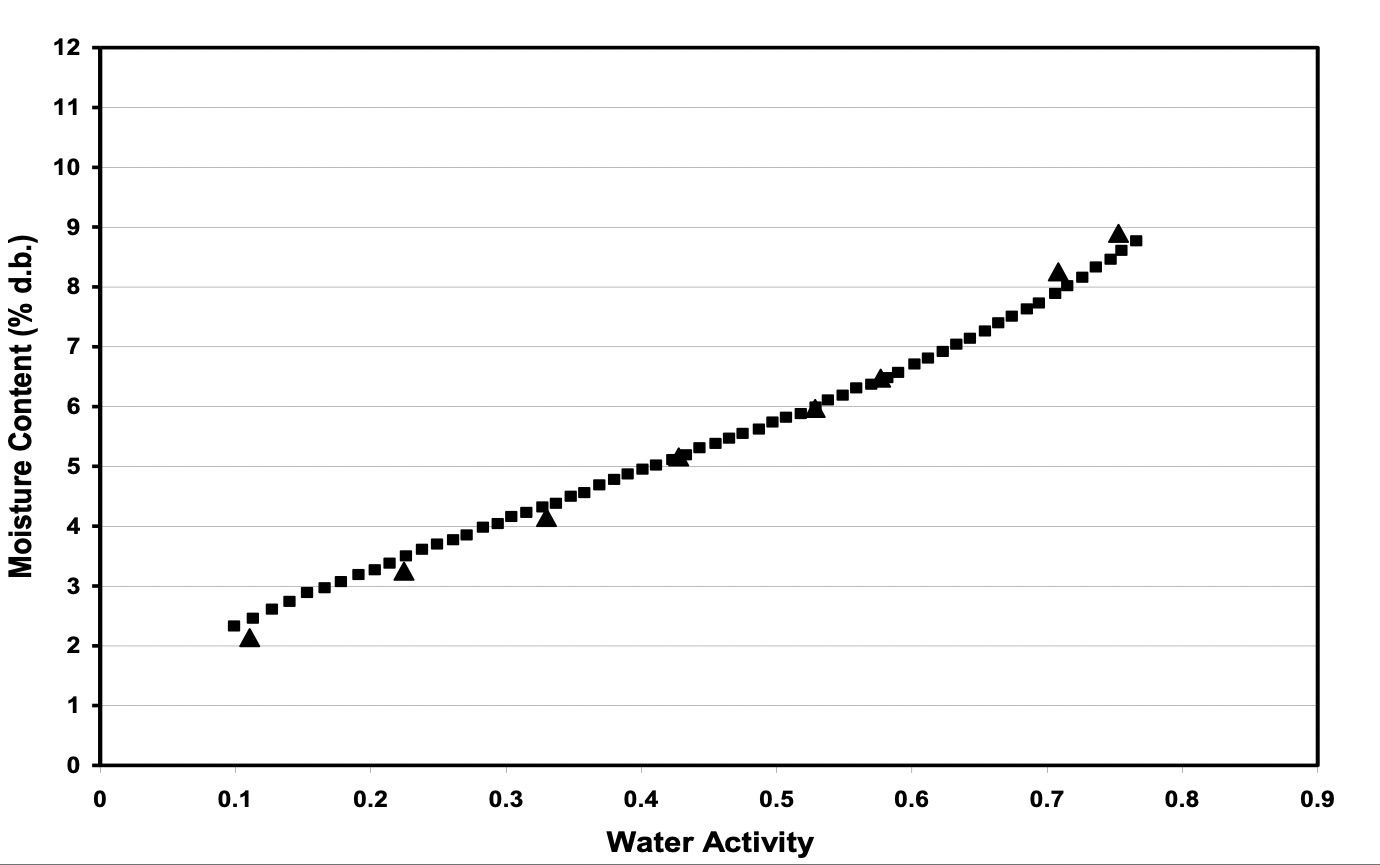
Figure 1. A comparison of adsorption isotherm curves at 25°C for MCC as recorded by the COST-90 project (▲) and as generated by the DDI method (■)
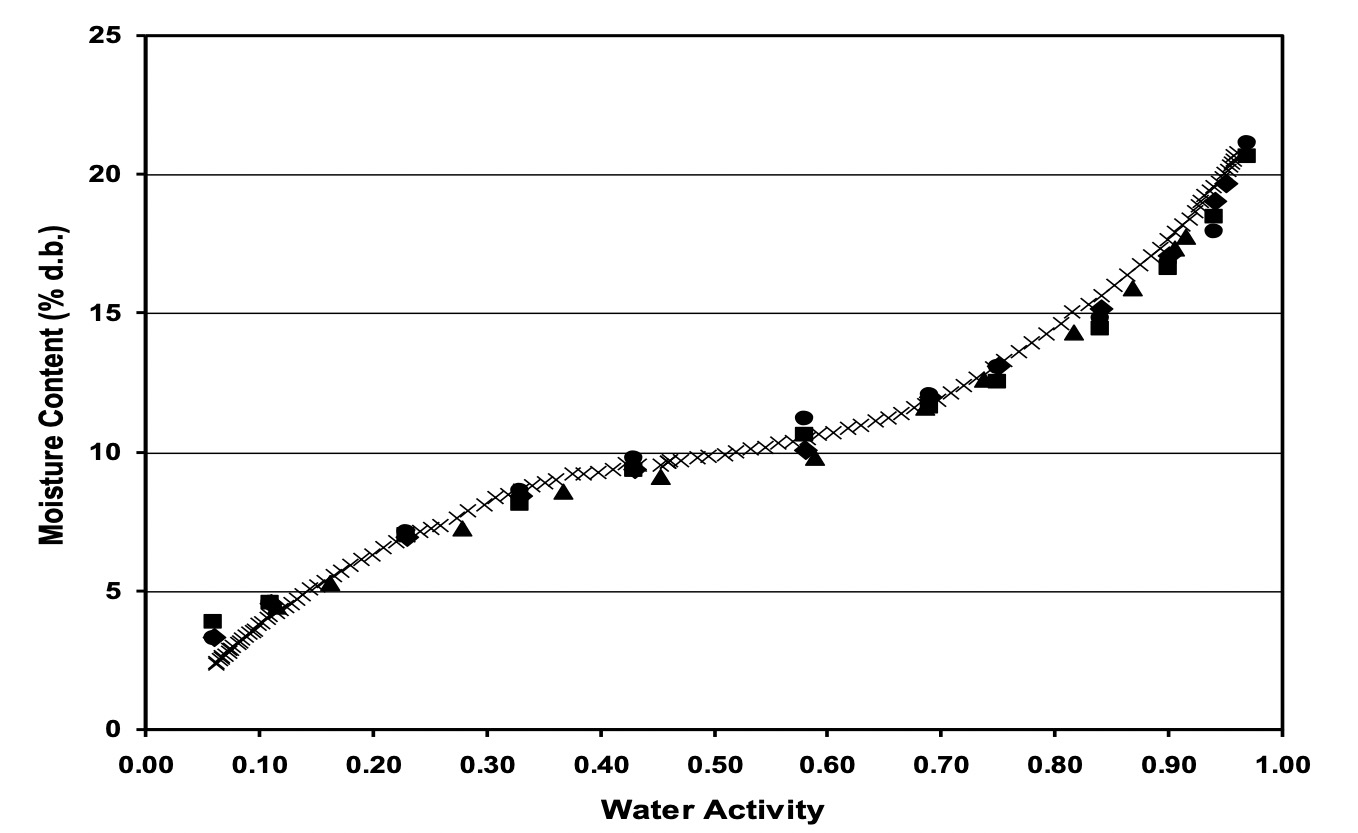
Figure 2. Corn starch working isotherms at 25°C when using desiccators with saturated salts (■), Proximity Equilibration Cell (●), DVS instrument 1 (♦), DVS instrument 2 (▲), and DDI (X) (DDI data from AQUALAB in-house testing, data for all other methods taken from Xin Yu, 2007)
However, for samples with slow diffusion rates, moisture movement through the sample is slow and complete diffusion of moisture into and out of the sample may be slow enough to give the appearance of vapor equilibrium in the headspace during water activity analysis. In reality, the moisture has not had time to be completely absorbed by the sample. Isotherms for these types of samples developed using the DDI method may have lower moisture contents during adsorption and higher moisture contents during desorption than isotherms obtained using other methods, resulting in higher levels of apparent hysteresis. Better agreement to other isotherms may be achieved, when using the DDI method, by reducing the sample size and lowering the wet or dry air flow rate to allow more moisture penetration into slow diffusing samples.
Should the methods be compared?
There may be those that become concerned when the DDI method results do not match results from traditional methods and argue that the moisture contents produced by the DDI method are not true equilibrium moisture contents. However, since all isotherm methods can achieve different matrix states, none of which may be true equilibrium, it is difficult to determine which method is most correct. It is important to understand that while DDI, DVS, and desiccator methods all can produce sorption isotherms, the DDI method is fundamentally different and it may be proper to consider DDI as a different, unique analysis.
Furthermore, while for many samples the methods give the same results, as illustrated in Figures 1 and 2, it is when they do not agree that the results can be the most interesting. For some materials, the moisture contents at a given water activity will be very different after weeks of equilibration time than they are after rapid exposure to high or low humidity. Time dependent physical changes that can occur as a product equilibrates at different water activity levels over weeks may not occur when using the DDI method. The methods are producing different results because they are inherently different.
For these types of materials, it would be inappropriate to compare the methods because they are providing different information. That does not mean that the DDI method is wrong and the other methods are right. In fact, the dynamic nature of the DDI method may actually give a more insightful understanding of the sorption characteristics of this type of product in real conditions since samples are rarely exposed to changes in moisture in stepwise progression but instead in a dynamic progression.
The value of the DDI method
The dynamic nature of the DDI method also allows for the rapid (1 or 2 days) generation of an unprecedented level of data resolution not practically possible with other isotherm methods (would take an unrealistic length of time). This resolution eliminates the need for extrapolation or interpolation, and gives a detailed view of sorption events.
Figure 3 illustrates isotherms for spray dried milk powder produced using the desiccator method and the DDI method. The moisture contents differ between the two methods because of the time dependent changes that have occurred over the long equilibration times of the desiccator method. In addition, time and labor constraints limit the number of data points generated by the desiccator method and interpolation using the GAB equation is required to complete the curve. The resolution of the DDI method produces a complete curve and interpolation by a model is not necessary. In fact, using a smooth curve model to characterize the isotherm would miss the most important results of the analysis. The DDI data indicates that important matrix changes are occurring, illustrated by sharp changes in sorption rates, at 0.42 aw, 0.559 aw, and 0.724 aw.
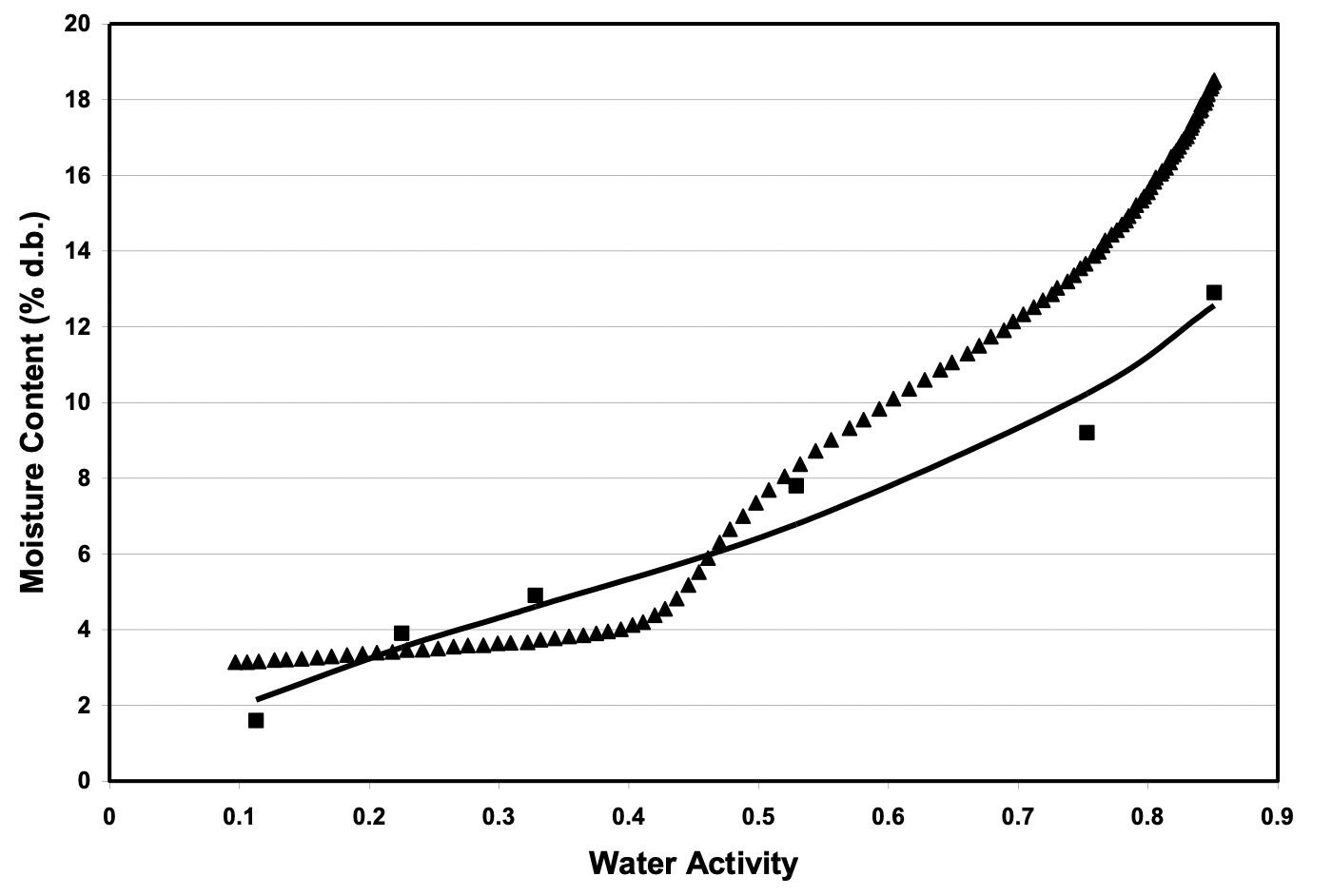
Figure 3. A comparison of adsorption isotherms at 25°C for spray dried milk powder conducted using the traditional desiccator method (■) and the DDI method (▲). Also shown is the GAB equation curve fitted to the traditional desiccator method data (DDI data from AQUALAB in-house testing, data for desiccator method adapted from Warburton and Pixton, 1978)
If just the desiccator method data and the data fitted to the GAB model were available in Figure 3, it would be impossible to identify any of the transitions. This explains why it has previously been the opinion of many that isotherm data could not be used to identify matrix transition points such as glass transition. However, matrix transitions are identifiable in the data from the DDI method.
Conclusion
The DDI method is a unique way of obtaining isotherms that can provide valuable information previously not obtainable from sorption isotherms. For many products, the DDI method generates isotherms comparable to other isotherms methods. However, for other product types, especially those that experience time dependent matrix changes, the DDI method can give different results than other methods because it is providing different sorption information. Finally, the high resolution of the DDI method makes it possible to observe previously unobservable sorption events.
Reference list
1. Warburton, S., and S.W. Pixton. 1978. The Moisture Relations of Spray Dried Skimmed Milk. Journal of Stored Products Research 14:143-158.
2. Wolf, W., W.E.L. Spiess, and G. Jung. 1985. Standardization of Isotherm Measurements (COST-project 90 and 90 BIS). p. 661-679. In D. Simatos, and J.L. Multon (ed.) Properties of Water in Foods in Relation to Quality and Stability. Martinus Nijhoff, Boston.
3. Xin Yu. 2007. Investigation of moisture sorption properties of food materials using saturated salt solution and humidity generating techniques. Ph.D. thesis, University of Illinois at Urbana-Champaign.
Newsletter signup
Case studies, webinars, and articles you'll love.
Receive the latest content on a regular basis!