Measuring Moisture Content: It’s More Complicated than You Think
Water activity is often thought to be a more complicated measurement than moisture content, but making accurate, repeatable moisture content measurements is not as simple as it seems. Learn why reporting bases, countless methods, and even the definition of “dry” make moisture content values hard to compare.

Why moisture content is harder to measure than it looks
Water activity, which provides information about product safety and quality, is often thought to be a more complicated measurement than moisture content. But making accurate, repeatable moisture content measurements is not as simple as it seems.
In theory, moisture content (MC) measurement is easy. Simply determine the amount of water in a product, and compare that to the weight of everything else in the product. In fact, it can be a difficult and complex process to obtain an accurate percentage of water in a product. Here’s why.
Moisture in food is reported on a wet basis or a dry basis
These different reporting methods can cause confusion. For the wet basis, the amount of water is divided by the total weight of the sample (solids plus moisture). For the dry basis, the amount of water is divided by the dry weight (solids only).
Unfortunately, moisture content is often reported only as a percentage, without any indication of which method was used. Though it is easy to convert between wet and dry basis, confusion and potential problems occur when comparisons are made between moisture contents reported on a different basis.
In addition, moisture content reported on a dry basis can actually result in a percentage value greater than 100%, causing more confusion.
Countless methods of moisture measurement means comparisons are nearly impossible
The AOAC lists 35 different methods for measuring moisture content. These are classified as either direct or indirect measurement methods.
Direct methods involve removing the water from the product (by drying, distillation, extraction, etc.) then measuring the amount of water by weighing or titrating. Direct methods provide the most reliable results, but are usually labor intensive and time consuming. Some examples include air oven-drying, vacuum oven-drying, freeze-drying, distillation, Karl Fischer, thermogravimetric analysis, chemical desiccation, and gas chromatography.
Indirect methods do not remove the water from the sample. Instead, they involve measuring some property of the food that changes as moisture content changes. These methods require calibration to a primary or direct method. Their accuracy is limited by the accuracy of the primary method.
Indirect methods are usually fast and require little sample preparation, but are less reliable than direct measurement methods. Examples of indirect measurement methods include refractometry, IR absorption, NIR absorption, microwave adsorption, dielectric capacitance, conductivity, and ultrasonic absorption.
Further complicating the process of measuring moisture content is that one measurement method doesn’t necessarily provide the same results as another, and the measurement method isn’t often reported with the moisture content value.
Even direct measurement methods don’t provide consistent results. Any method that requires heating (i.e., loss-on-drying) can cause samples to lose organic volatiles or sample decomposition – especially for samples containing high levels of sugar. For example, if organic volatiles are present in a sample or if the sample decomposes while being dried, a Karl Fischer analysis, which is not susceptible to volatile loss or decomposition, will give different results than a loss-on-drying analysis.
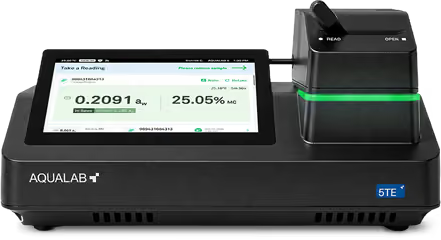
AQUALAB 5TE
Water activity and moisture content in a single 60-second test.
- MC + aw in one
- Results in 1 minute
- Accurate to ±0.003 aw
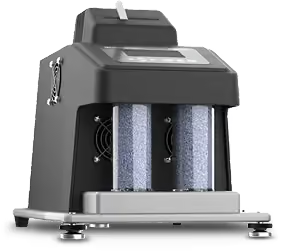
AQUALAB VSA
Make detailed moisture maps to predict, understand, and control moisture’s effects. High-resolution moisture sorption isotherms for shelf life prediction.
- Isotherms in <48 hours
- 200+ data points / isotherm
- 5 min. test setup
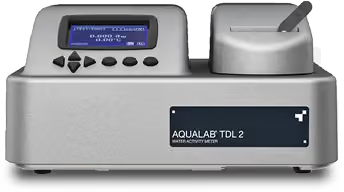
AQUALAB TDL 2
Precise water activity readings for volatile and complex samples.
- Tunable diode laser sensor
- Read highly volatile substances
- Accurate to ±0.005 aw
Variability is difficult to avoid
One answer to these problems is to simply use a consistent method and only compare values that have been obtained in the same way. Unfortunately, consistency in measurement methods for moisture content analysis still will not eliminate all problems.
Consider, for instance, loss-on-drying. This method seems simple enough. A sample is weighed, and the weight is recorded. The sample is then transferred to an oven, allowed to dry, and the dry weight is measured. The amount of water is determined by subtracting the dry weight from the initial weight, and the moisture content is then calculated as the amount of water divided by the dry weight or total weight, depending on the reporting method.
Even this simple loss-on-drying method is mined with potential variability traps. The most fundamental is that the term ‘dry’ has no real scientific meaning and has never been well defined. Instead, an arbitrary dryness that is reproducible has to be established for each sample.
“Dryness” is often defined as the point at which weight loss ends. However, thermogravimetric graphs show that weight loss levels off at different temperatures for different products. Also, depending on the product, the length of time needed to achieve “dryness” will differ, and a temperature which produces “dryness” in one product may cause decomposition in another.
This means that each sample has a unique ideal oven temperature and drying time. This ideal time/temperature combination is available in the literature for some products, but there are many for which it is not available. It is difficult to know which combination to use for untested products. If the same time/temperature combination is not used, the resulting moisture contents should not be compared.
Another complication is that many ovens set at one temperature can vary over time from that temperature by as much as 15 °C, and two ovens set to the same temperature can vary by as much as 40 °C.
Sources of variation
Additional sources of variation for just the loss-on-drying method include: oven vapor pressure, sample preparation methods, sample particle size, sample weighing, and post-drying treatment.
It is interesting that despite the potential pitfalls, when a loss-on-drying moisture content is reported in literature, it is immediately accepted as correct. In addition, when comparisons are made between moisture content methods and one of those methods is loss-on-drying, it is always assumed that the loss-on-drying measurement is correct.
The best way to define dry
Would be to identify an oven-dry water activity level.
Moisture content determination
Defining “dry” would be helpful in eliminating some of the inconsistency associated with moisture measurement.
The best way to define dry would be to identify an oven-dry water activity level. Then, the dry weight would be the weight of the sample when it has achieved this oven-dry water activity level.
Under common ambient conditions of 25 °C and 30% RH, an oven set to 95 °C would create an oven-dry water activity of 0.01 aw inside the oven, assuming that the vapor pressure in the oven is the same as the air. An oven that maintained conditions where its oven-dry water activity was always 0.01 aw, regardless of ambient conditions, would create a scientifically “dry” condition. In this type of oven, any product could be declared dry when its weight stopped changing. Its water activity would be 0.01 aw, and its weight would be the dry weight.
The vapor pressure and temperature of the oven could be adjusted to prevent release of volatiles as well, as long as the water activity in the oven was maintained at 0.01 aw. Using this method would eliminate the inconsistency that results from multiple measurement methods and an unclear definition of “dry.”
More accurate moisture analysis
Moisture content provides valuable information about yield and quantity, making it important from a financial standpoint. It also provides information about texture, since increasing levels of moisture provide mobility and lower the glass transition temperature. But obtaining correct and consistent moisture content values can be difficult, and a moisture content measurement cannot be taken at face value without information about the methods used to generate it.
Additional problems arise when the amount of water in a product is used to tell a story it doesn’t really tell, involving product consistency, quality, or microbial safety. In these and other cases, water activity is the more accurate measurement.
For a complete moisture analysis, food and pharmaceutical developers should measure both water content and water activity. In addition, moisture sorption isotherms may be used to pinpoint where optimal shelf life, texture, safety, and quality can be achieved and maintained.
Frequently asked questions
What is the difference between wet basis and dry basis moisture content?
For the wet basis, the amount of water is divided by the total weight of the sample (solids plus moisture). For the dry basis, the amount of water is divided by the dry weight (solids only). Moisture content reported on a dry basis can result in a percentage value greater than 100%.
How many methods are there for measuring moisture content?
The AOAC lists 35 different methods for measuring moisture content. They are classified as either direct methods, which remove the water from the product and then weigh or titrate it, or indirect methods, which measure a property of the food that changes as moisture content changes.
Why is loss-on-drying moisture content so variable?
The term “dry” has no real scientific meaning, so an arbitrary dryness has to be established for each sample. Each sample has a unique ideal oven temperature and drying time, ovens set at one temperature can vary over time by as much as 15 °C, and two ovens set to the same temperature can vary by as much as 40 °C.
Why should I measure both moisture content and water activity?
Moisture content provides valuable information about yield, quantity and texture, but it can be difficult to measure consistently. When the amount of water is used to say something about product consistency, quality or microbial safety, water activity is the more accurate measurement. For a complete moisture analysis, food and pharmaceutical developers should measure both.
Drive your company’s total moisture performance
Learn how